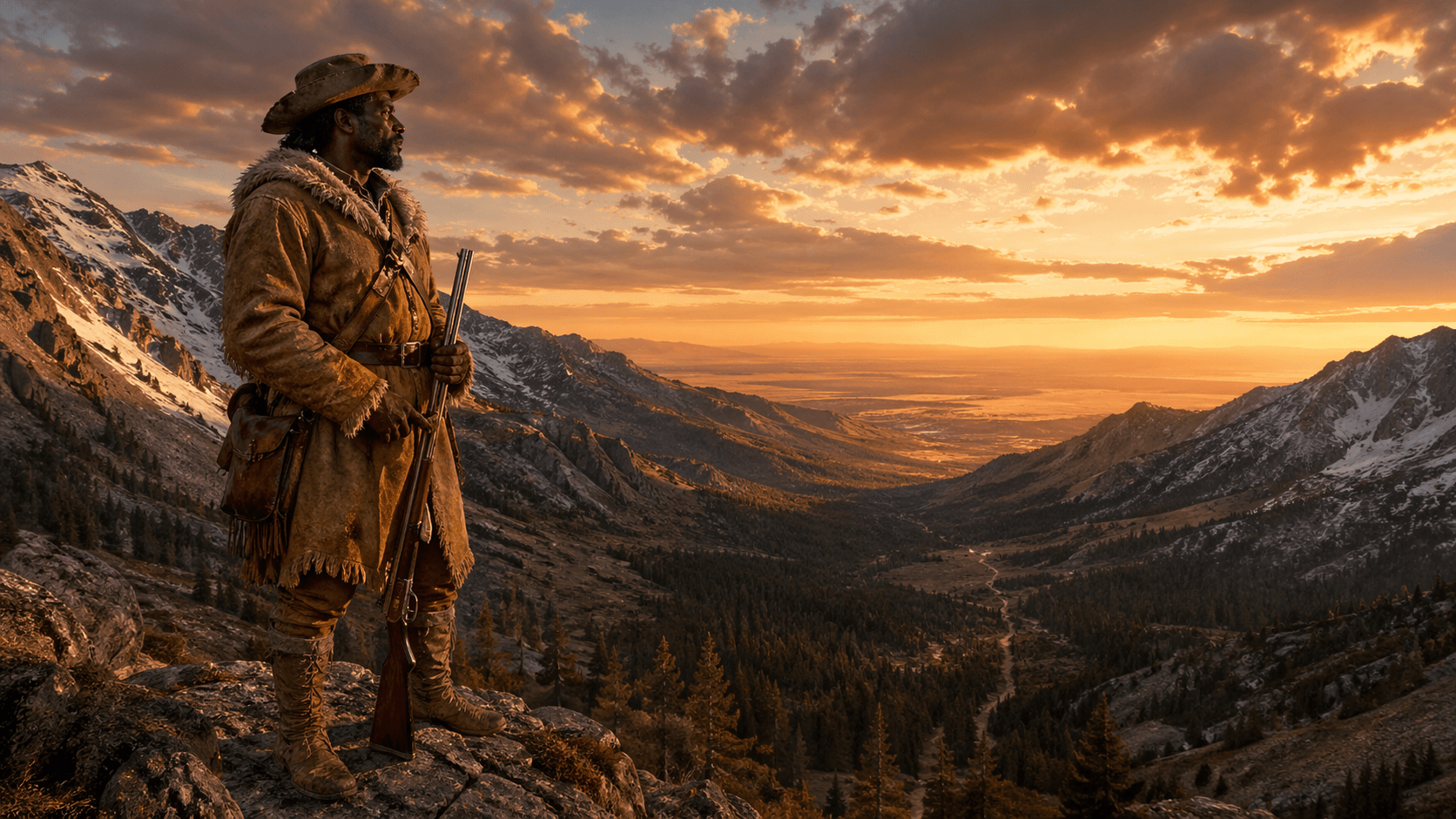
James Pierson Beckwourth: The Black Explorer Who Mapped the American West
Table of Contents
- Introduction: A Man History Tried to Forget
- Early Life: Born in Slavery, Raised with Purpose
- Ashley’s Hundred: The Expedition That Changed Everything
- Life Among the Crow: Eight Years That Defied Every Expectation
- Seminole Wars, Trading Posts, and a Life That Never Stood Still
- Beckwourth Pass: The Discovery That Opened California
- The Autobiography: A Black Man’s Story in His Own Words
- Legacy, Death, and a Name That Lives in the Land
- Why James Pierson Beckwourth Matters Today
- Key Takeaways
- Frequently Asked Questions
 Introduction: A Man History Tried to Forget
Most Americans have never heard the name James Pierson Beckwourth. That is not a mistake. It is a pattern.
The story of the American West has been told and retold through a very specific lens one that rarely made room for the Black men and women who explored it, shaped it, and helped build it. James Pierson Beckwourth, one of the most extraordinary Black explorers in American history, is perhaps the clearest example of what gets lost when that lens narrows too far.
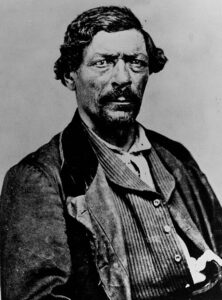
He was born into slavery and died a free man in the mountains he loved. Between those two facts lies a life so full of adventure, survival, courage, and contradiction that even his contemporaries sometimes struggled to believe it. He trapped beaver in the frozen Rocky Mountains alongside Jim Bridger and Kit Carson. He lived for nearly a decade among the Crow Nation, rising to a position of genuine leadership within their society. He discovered Beckwourth Pass still in use today a route through the Sierra Nevada that thousands of Gold Rush settlers traveled to reach California. He dictated the first published autobiography of an American mountain man.
And yet, for most of American history, his name barely appeared in the textbooks.
This is the complete story of James Pierson Beckwourth; Black explorer, mountain man, fur trapper, Crow war chief, trail blazer, author, and one of the most remarkable figures the American frontier ever produced.
Early Life: Born in Slavery, Raised with Purpose
James Pierson Beckwourth was born on April 26, 1798, in Frederick County, Virginia. From his very first breath, his life defied easy categorization. His father was Sir Jennings Beckwith a white Virginia planter of English descent, a Revolutionary War military officer, and a man from a family connected to the British aristocracy. His mother was an enslaved African American woman in the Beckwith household.
Under the laws of Virginia at the time, James was born a slave legally the property of his own father. It is a detail that reveals the foundational cruelty of the system James would spend his entire life escaping and transcending.
Around 1809, when James was roughly ten years old, Jennings Beckwith moved his family including all of his enslaved people westward to the Louisiana Territory, settling near the confluence of the Missouri and Mississippi Rivers, in what is now Missouri. St. Louis at that time was the gateway to the American West, a city buzzing with fur traders, explorers, and adventurers of every background.
Despite James’s legal status as a slave, his father raised him differently from the other enslaved people in the household. Jennings sent young James to school in St. Louis for approximately four years an extraordinary opportunity for any child of that era, let alone an enslaved one. James learned to read and write with genuine proficiency. He hunted with his father. He was treated, in many observable ways, as a member of the family even as the law refused to recognize him as one.
At around age fourteen, Jennings Beckwith arranged for James to apprentice with a blacksmith in St. Charles, Missouri. It was a practical trade, a path toward self-sufficiency. James learned it well but the forge could not hold him. At around age nineteen, he quarreled with his employer and walked away from the apprenticeship. His father, in what historians have documented as a formal legal act, eventually executed a deed of emancipation for James in St. Louis court records indicate this occurred between 1824 and 1826.
When James Beckwourth walked away from that courthouse as a free man, he was twenty-six years old, skilled with his hands, educated enough to read and write, and facing a continent that had almost no place for a free Black man who wanted to live on his own terms.
He went West.
Ashley’s Hundred: The Expedition That Changed Everything
In 1822, General William Henry Ashley placed an advertisement in a St. Louis newspaper. He was organizing a fur-trapping expedition into the Rocky Mountains and needed men specifically, “enterprising young men” willing to ascend the Missouri River and spend years in the wilderness trapping beaver. The men who answered that call would become known as Ashley’s Hundred, and they would shape the history of the American West.
Among them were men whose names have since become legendary: Jim Bridger, Hugh Glass (whose near-death experience inspired the film The Revenant), Jedediah Smith, William Sublette, and Thomas Fitzpatrick. And James Pierson Beckwourth, the Black explorer from Missouri who was as free as the law allowed and as determined as any man on the frontier.
Beckwourth initially joined the expedition in a support role as a groom, blacksmith, and general hand. But the mountains have a way of revealing character, and James Beckwourth had character in abundance. As the expedition pushed into the Rocky Mountains, crossing the Continental Divide and trapping in the frozen streams of what is now Wyoming and Colorado, Beckwourth distinguished himself through physical endurance, skill with horses and livestock, and an extraordinary ability to communicate and negotiate with Native American peoples they encountered along the way.
By 1825, Beckwourth was a confirmed mountain man no longer anyone’s servant, but a free trapper working for himself in one of the most demanding environments on earth. That same year, he attended the first annual rendezvous on Henry’s Fork of the Green River the annual gathering at which mountain men sold their furs, resupplied, and celebrated surviving another year in the wilderness.
James Pierson Beckwourth had found his world.
Life Among the Crow: Eight Years That Defied Every Expectation
In 1829, James Pierson Beckwourth made a decision that would define the next chapter of his life and cement his reputation as one of the most unusual figures in frontier history. He went to live with the Crow Nation.
Exactly how this came about depends on which account you believe. Beckwourth’s own autobiography claims that the Crow recognized him as a long-lost member of their tribe a child stolen by Cheyenne raiders in infancy and sold to white settlers. Whether that story is literally true or a piece of collaborative storytelling between Beckwourth and the Crow, the result was the same: he was welcomed into the tribe, given the name “Bull’s Robe,” and permitted to live among them as one of their own.
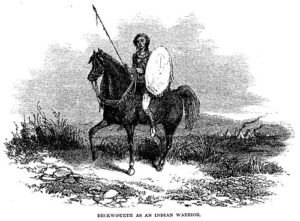
What is not disputed is what happened next. Over the following seven to nine years, James Pierson Beckwourth learned the Crow language, adopted their customs, and rose through their social structure with remarkable speed. He married the daughter of a Crow chief. He participated in raids against rival nations, including the Blackfoot the Crow’s traditional enemies. He led successful war parties. According to his autobiography, he eventually rose to the highest war chieftaincy of the Crow tribe, a claim that has been disputed by some historians but is supported, at least partially, by independent accounts from fur traders and missionaries who encountered him during this period.
The significance of this chapter of his life is difficult to overstate for any student of Black history or American frontier history. Here was a man born into slavery in Virginia, carrying the legal status of property, who within three decades of his birth had become a recognized war leader of one of the most powerful Native nations on the Great Plains.
He was not invisible out there. He was not marginal. He was not forgotten. He was, for a time, exactly at the center of a world that operated entirely on its own terms where what mattered was what a man could do, how well he could fight, how truthfully he could read the land, how faithfully he could honor the people around him.
About 30 percent of Black homesteaders in the later frontier era would file individual land claims with no nearby Black community to support them navigating hostile terrain alone. Beckwourth had done the same thing a generation earlier, in an even more extreme form, and he had not merely survived. He had thrived.
 Seminole Wars, Trading Posts, and a Life That Never Stood Still
In 1837, the American Fur Company did not renew Beckwourth’s contract, effectively ending his formal relationship with the Crow and pulling him back into the wider American world. He returned to St. Louis, then volunteered with the United States Army to serve in the Second Seminole War in Florida. Historical records indicate he served as a civilian wagon master though his autobiography, characteristically, describes a more dramatic role.
After Florida, Beckwourth returned west, ranging across New Mexico and Colorado. He established trading posts including operations near Bent’s Fort on the Arkansas River and served as an independent trader to the Cheyenne for a period. In 1842, he settled briefly in Pueblo, Colorado, with a woman named Maria Luisa Sandoval and their daughter.
Over the years, James Pierson Beckwourth married at least four women: two Native Americans, a Hispanic woman (Maria Luisa Sandoval), and an African American woman. He had children by several of them, though his perpetual restlessness meant he was rarely in one place long enough to raise them. This is one of the genuine complexities in his story the same qualities that made him extraordinary as an explorer made him an inconsistent and largely absent father. His life was spent in motion, and the people who loved him paid a price for that.
By the late 1840s, Beckwourth had become a highly sought guide and scout. He served as chief scout for General John C. Frémont in 1848. He operated saloons and trading posts in New Mexico. He became a celebrated host and storyteller in the California mining camps. And then, in the spring of 1850, he made the discovery that would permanently attach his name to the geography of the American West.
Beckwourth Pass: The Discovery That Opened California
In the spring of 1850, James Pierson Beckwourth was prospecting in the remote Sierra Nevada mountains of northern California, in the region near present-day Lassen Volcanic National Park. He was not panning for gold with great success. He was, as he had been for much of his life, moving following his instincts across terrain most men would not have dared.
One day, he looked west and saw what looked like a low gap in the mountain range. At the end of April 1850, he led three companions toward it. What they found changed westward migration in America.
Beckwourth Pass sits at approximately 5,221 feet above sea level nearly a third of a mile lower in elevation than the notorious Donner Pass to the south, where in 1846 a snowbound wagon party had resorted to cannibalism to survive. The lower elevation meant the pass would remain snow-free for longer, that it offered a more gradual approach for wagons and livestock, and that it provided a substantially safer route for the thousands of emigrants and Gold Rush prospectors trying to reach California.
Beckwourth immediately understood what he had found. He and his companions spent the summer and fall of 1850 opening a road through the pass. In the spring of 1851, he actively promoted what he called his “New Emigrant Route,” securing backing from merchants in Marysville, California who understood that a direct eastern wagon route to their city would accelerate its growth dramatically.
In the fall of 1851, James Pierson Beckwourth personally led the first wagon train of settlers along the Beckwourth Trail into Marysville. Among the settlers in that historic train was a ten-year-old girl named Josephine Donna Smith who would later take the pen name Ina Coolbrith and, in 1915, become California’s first Poet Laureate. The first wagon train through Beckwourth’s pass carried a future California literary icon.
Between 1851 and 1854, more than 1,200 emigrants traveled the Beckwourth Trail, leading 12,000 head of cattle, 700 sheep, and 500 horses into California. Beckwourth built a ranch, a trading post, and a hotel near the pass. He offered supplies to emigrants often on credit, a generosity that cost him financially but earned him a reputation for genuine hospitality.
Today, Beckwourth Pass is designated as California Historical Landmark Number 336. The pass is still used by Highway 70 and the Union Pacific Railroad. The town of Beckwourth, California, still bears his name. And a cabin he built near the pass now the Jim Beckwourth Cabin Museum in Plumas County, California still stands as a tangible piece of the history he made.
A Black explorer, born into slavery in Virginia, left his name permanently on the landscape of California. That is not a small thing.
 The Autobiography: A Black Man’s Story in His Own Words
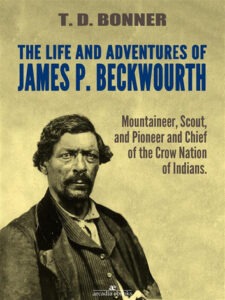
In the winter of 1854 to 1855, James Pierson Beckwourth dictated his life story to a journalist and justice of the peace named Thomas D. Bonner, who happened to be staying at his trading post near the pass. The resulting book The Life and Adventures of James P. Beckwourth: Mountaineer, Scout, and Pioneer, and Chief of the Crow Nation of Indians was published in New York and London in 1856.
It was the first published autobiography of an American mountain man.
From the moment it appeared, the book was controversial. Beckwourth’s reputation as a storyteller his contemporaries called him a “gaudy liar” and a “yarn-spinner” meant that even readers who admired him took his more dramatic claims with significant skepticism. Stories of bear attacks survived by hand-to-hand combat, of war parties where he personally claimed to have killed dozens of enemies, of rising to supreme chieftaincy over the entire Crow Nation these were the kinds of claims that historians immediately questioned.
And yet. Read carefully, The Life and Adventures reveals something that his critics often missed: underneath the exaggeration and the tall tale, there is a genuine and vivid account of what the American frontier actually looked like its violence and its beauty, its freedom and its brutality, the complex webs of relationship between mountain men, Native peoples, fur trading companies, and the advancing tide of American settlement. Beckwourth witnessed the rise and fall of the beaver fur trade. He watched diseases devastate Native communities. He lived through the California Gold Rush and its transformation of the western landscape. He saw, with unusual clarity for his time, what Manifest Destiny actually cost the peoples who already called that land home.
The autobiography was translated into French in 1860 evidence that Beckwourth’s fame, however complicated, was genuinely international.
Modern historians, reassessing the book with more nuanced tools, have largely concluded that while Beckwourth embellished freely a recognized literary tradition among frontier storytellers, from Davy Crockett to Kit Carson the core events of his autobiography are broadly consistent with historical records. The mountains were real. The battles were real. The years among the Crow were real. The pass was real.
And crucially: as a Black man, Beckwourth faced a standard of skepticism that his white contemporaries did not. When Kit Carson exaggerated and he did it was called frontier bravado. When James Pierson Beckwourth exaggerated, it was called unreliable testimony from a man who couldn’t be trusted.
That double standard is itself a fact of American history worth remembering.
Legacy, Death, and a Name That Lives in the Land
In his later years, James Pierson Beckwourth settled for a time in Denver, Colorado, where he owned a saloon and drew customers with his irresistible stories. He served as a guide and interpreter for various military operations. In 1864, he was present in a role that historians have debated at the Sand Creek Massacre, in which Colorado militia attacked a peaceful Cheyenne and Arapaho encampment, killing an estimated 150 to 200 people, primarily women, children, and elderly. What Beckwourth’s precise role was in those events remains a subject of historical discussion.
In 1866, Beckwourth accepted a request that he could not refuse. The Crow Nation the people who had named him Bull’s Robe, who had elevated him to leadership, who had, in some real sense, made him the man he became asked him to return and serve as their guide once more. He traveled from Fort C.F. Smith in Montana Territory to a Crow village along the Bighorn River.
There, on October 29, 1866, James Pierson Beckwourth died.
The exact cause remains unknown. One account says he was poisoned — that the Crow, unable to persuade him to stay permanently, killed him so that his spirit would remain with them forever. Another says he died peacefully of natural causes after a period of illness. Whatever the truth, he died among the people who had shaped the most meaningful years of his life, in the land that he had spent forty years exploring and loving.
He was sixty-eight years old. He had been born a slave in Virginia and died a free man in the mountains he had helped map.
His legacy is written into the American landscape in ways that cannot be erased. Beckwourth Pass. Beckwourth Trail. The town of Beckwourth, California. California Historical Landmark No. 336. The Jim Beckwourth Cabin Museum, still open to visitors today.
The Crow people he lived among gave him a name: Bull’s Robe. His fellow mountain men gave him another: Bloody Arm, for his skill and ferocity in combat. History has given him a third, quieter designation one of the most important Black explorers in American history, a man whose life challenges every narrow story we have ever told about who built the American West.
Why James Pierson Beckwourth Matters Today
There is a reason that writers like Lonesome Augustine return, again and again, to the stories of men like James Pierson Beckwourth.
It is not nostalgia. It is not entertainment, though these stories are genuinely riveting. It is something more necessary than either of those things.
When we look at the full arc of Black American history from the enslaved people who arrived at Hampton, Virginia in 1619, through the Reconstruction era, through the Great Migration, through the Exodusters who moved west in search of land and freedom we find, over and over, the same truth: Black Americans have always been present, always been central, and always been systematically removed from the story that gets told.
James Pierson Beckwourth did not disappear from history because he was unimportant. He disappeared because it was more convenient for certain tellers of American history to pretend that the West was built by one kind of person.
His story, told fully and honestly, dismantles that pretense. It shows us a Black explorer who navigated the most extreme environments of the American frontier not as a servant, not as a curiosity, but as a peer and often as a leader. It shows us a man who, despite being born into a system designed to crush his humanity, found a way to live on his own terms, make his own choices, and leave his name literally on the landscape of this country.
For readers who want to go deeper into Black frontier history into the stories of men and women who shaped the American West in ways that textbooks rarely acknowledge books like Dark Prairie by Lonesome B. Augustine offer something that dry historical accounts cannot: the emotional truth of what it meant to live those lives, to carry that history in your body, and to keep moving forward anyway.
The mountains James Beckwourth crossed are still there. The pass he discovered still carries people through the Sierra Nevada. The story he lived is still waiting to be told, fully, to everyone who has never heard it.
This is that story.
Key Takeaways
| Fact | Detail |
|---|---|
| Full Name | James Pierson Beckwourth (born James Beckwith) |
| Born | April 26, 1798, Frederick County, Virginia |
| Died | October 29, 1866, Crow Territory (present-day Montana/Wyoming) |
| Birth Status | Born into slavery; father was his white enslaver, Sir Jennings Beckwith |
| Freedom | Formally emancipated by his father, 1824–1826, St. Louis court |
| Key Career | Fur trapper, mountain man, Black explorer, Crow war chief, trail blazer, author |
| Famous Nickname | “Bloody Arm” (for fighting skill); “Bull’s Robe” (Crow Nation name) |
| Greatest Discovery | Beckwourth Pass, Sierra Nevada, 1850 elevation 5,221 ft, lowest Sierra pass |
| Trail Built | Beckwourth Trail (1851) 1,200+ emigrants, 12,000+ cattle used it by 1854 |
| Autobiography | The Life and Adventures of James P. Beckwourth (1856) first mountain man autobiography |
| Crow Nation Rank | War leader and chief lived among Crow for 7–9 years, named “Bull’s Robe” |
| Colleagues | Jim Bridger, Kit Carson, Jedediah Smith, Hugh Glass |
| Legacy Sites | Beckwourth Pass (CA Landmark #336), town of Beckwourth, CA, Jim Beckwourth Cabin Museum |
| Historical Significance | One of the most important Black explorers of the American frontier |
Frequently Asked Questions
Who was James Pierson Beckwourth? James Pierson Beckwourth was a Black explorer, fur trapper, mountain man, Crow war chief, and trail blazer who is considered one of the most significant African American figures of the 19th-century American West. Born into slavery in Virginia in 1798, he was emancipated by his father as a young man and went on to spend decades exploring the Rocky Mountains, living among the Crow Nation, and discovering Beckwourth Pass through the Sierra Nevada.
What was James Beckwourth known for discovering? James Beckwourth is best known for discovering Beckwourth Pass in 1850 — the lowest elevation pass through the Sierra Nevada mountain range, located at 5,221 feet above sea level near present-day Portola, California. He subsequently developed the Beckwourth Trail, which became a major route for emigrants and Gold Rush settlers traveling to California. Between 1851 and 1854, more than 1,200 emigrants traveled the trail, leading tens of thousands of livestock into California.
How did James Beckwourth die? James Beckwourth died on October 29, 1866, in Crow Territory, in the area of present-day Montana and Wyoming. He had traveled there to serve as a guide for the Crow Nation at their request. The exact cause of his death is unknown. One account suggests he was poisoned by the Crow, who wanted his spirit to remain with them permanently. Another account holds that he died of natural causes. He was approximately 68 years old at the time of his death.
Who was James Beckwourth’s wife? James Beckwourth married at least four women over the course of his life. Two were Native American women he married during his years with the Crow Nation, one was a Hispanic woman named Maria Luisa Sandoval (with whom he had a daughter named Matilda), and one was an African American woman. Marriage between mountain men and Native American women was common in the frontier era, as these alliances provided both cultural connections and practical benefits for fur trading operations.
What were some interesting facts about James Beckwourth? Among the most notable facts about James Beckwourth: he was born a slave to his own father; he rose to a war leadership position within the Crow Nation; his 1856 autobiography was the first ever published by an American mountain man; Beckwourth Pass is still designated as California Historical Landmark No. 336 and is still used by a major highway and railroad today; he traveled alongside some of the most famous mountain men in American history including Jim Bridger, Kit Carson, and Jedediah Smith; and despite being one of the most widely traveled Americans of the 19th century, he remains largely absent from mainstream history textbooks.
Why is James Beckwourth important to Black history? James Pierson Beckwourth represents a critical and often overlooked dimension of Black American history the story of Black men and women who were active participants in the exploration and settlement of the American West. As a Black explorer who rose to genuine prominence in a world dominated by white men, he challenged the racial hierarchies of his time through sheer skill and determination. His discovery of Beckwourth Pass and development of the Beckwourth Trail had lasting, practical consequences for westward expansion in America. His autobiography, the first of its kind by a mountain man of any background, is a primary historical document. His life is evidence that the American West was built by people of every race and background not the narrow cast of characters that most history books have presented.
Where can I visit sites related to James Beckwourth today? Several sites connected to James Pierson Beckwourth still exist and can be visited. Beckwourth Pass, near Portola in Plumas County, California, is California Historical Landmark No. 336. The Jim Beckwourth Cabin Museum on Rocky Point Road near Portola is open to visitors, particularly during summer weekends. The town of Beckwourth, California, also bears his name. Highway 70 and the Union Pacific Railroad still use the pass he discovered in 1850.
Lonesome B. Augustine is a Black American author, veteran, and Christian speaker based in Fredericksburg, Virginia. His writing explores the untold stories of Black pioneers, faith, and frontier life. Explore his novels Dark Prairie and ICE: A Story of Love, Crime and Politics — available now.
For more stories on Black frontier history: