 How the Homestead Act of 1862 Both Freed and Failed Black Farmers
There is a version of American history that gets taught in classrooms across the country. It goes something like this: Abraham Lincoln signed the Homestead Act of 1862, the West opened up, and hardworking families claimed their 160 acres and built something from nothing.
That version is not wrong. It is just incomplete.
Because for Black Americans, men and women who had worked other people’s land their entire lives without a single acre to call their own, the Homestead Act of 1862 was something far more complicated. It was a door that swung open and slammed shut at the same time. A promise wrapped in a system designed, in many ways, to break it.
This is the story they left out of the textbook.
What the Homestead Act of 1862 Actually Said
President Lincoln signed the Homestead Act of 1862 into law on May 20, 1862. It took effect on January 1, 1863 the same day the Emancipation Proclamation declared enslaved people in Confederate states to be free.
According to the National Archives, the law granted any adult American citizen 160 acres of surveyed public land in the West. All they had to do was pay a small filing fee, live on the land for five years, and improve it build a home, work the soil, make something grow. After five years, the land was theirs, free and clear.
The act did not mention race. It did not say “whites only.” In theory, it opened land ownership to citizens of every background including women, immigrants, and formerly enslaved people.
In theory.
The Gap Between Law and Reality
Here is the number that tells the real story.
Between 1862 and the early 20th century, the U.S. government distributed more than 270 million acres of land through the Homestead Act of 1862. Of that, approximately 3,500 Black claimants successfully obtained land titles accounting for roughly 650,000 acres, according to research conducted by the University of Nebraska and funded by the National Park Service.
That means Black Americans who made up a significant portion of the population in the post-Civil War South received less than 0.25% of the land distributed.
The gap between law and lived reality was not an accident. It was a structure.
When the Civil War ended in 1865, most formerly enslaved people had nothing. No savings. No tools. No horses. No way to travel hundreds of miles west to file a land claim. Many were locked into year-long sharecropping contracts that were, in practice, nearly impossible to legally leave. Leaving before the contract ended could result in arrest a system of re-enslavement by another name.
Even for those who found a way west, the obstacles kept coming. Local land offices sometimes refused Black applicants outright. White settlers challenged their claims in courts that rarely ruled in their favor. And the land itself much of what was left for Black claimants by the time they could access it was often the least desirable: dry, difficult to farm, far from water or markets.
The Southern Homestead Act: A Promise That Expired
Congress recognized the problem, at least partially. In 1866, lawmakers passed the Southern Homestead Act, which opened 46 million acres of public land across Alabama, Arkansas, Florida, Louisiana, and Mississippi specifically to help formerly enslaved people become landowners in the South.
For the first six months, only freedmen and loyal Union supporters could claim land under it. On paper, it was an attempt at reparative policy.
But the land available was largely swampland, heavily wooded terrain, and soil too poor for profitable farming. There was often only one land office per state meaning Black farmers had to travel weeks just to file a claim, a journey that cost more than the filing fee itself. And the political will behind the act was shallow.
By 1876 just ten years after it passed the Southern Homestead Act was repealed. The window closed before most Black families could step through it. As the Civil Rights Teaching timeline on Black land documents, this repeal marked one of the earliest and most consequential policy reversals in the history of Black economic opportunity in America.
Those Who Made It Through
And yet, some did.
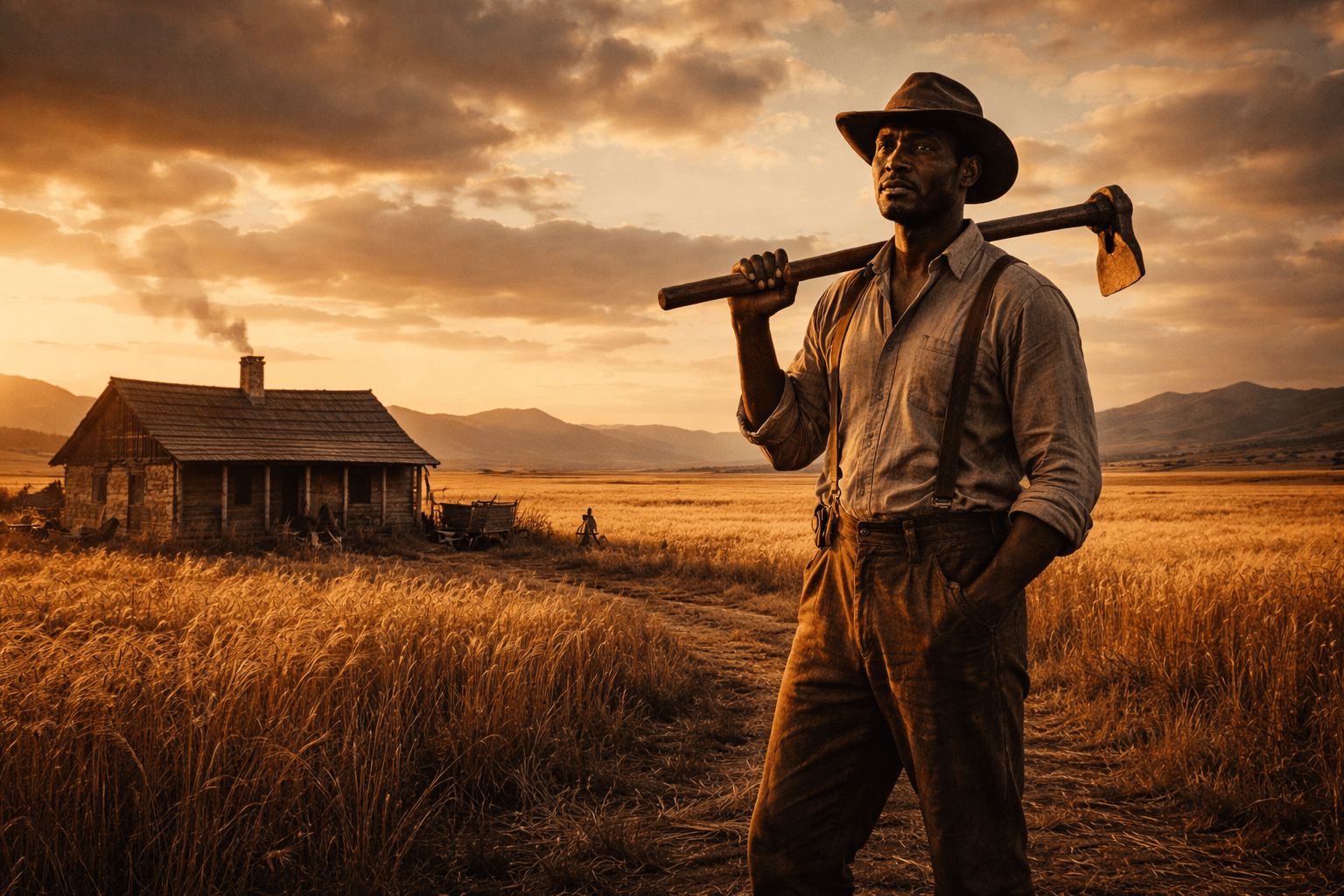
Black homesteaders built communities across the Great Plains that history has largely forgotten. Nicodemus, Kansas founded in 1877 by freed slaves from Kentucky became one of the most remarkable experiments in Black self-determination the country had ever seen. Residents built their own churches, their own schools, their own newspapers. They organized investment clubs and reading circles. They farmed the prairie soil through grasshopper plagues, droughts, and the constant threat of violence. Today, Nicodemus National Historic Site preserves what remains of that original community.
DeWitty, Nebraska. Dearfield, Colorado. Blackdom, New Mexico. These were not footnotes. These were full communities built by Black men and women who had every reason to quit and chose, over and over again, not to.
About 30 percent of Black homesteaders filed claims entirely on their own, far from other African American settlers, which means they faced the isolation and hostility of the frontier without even the comfort of community around them. And still, many persisted.
Among those who homesteaded was Oscar Micheaux who would later become the first major African American filmmaker in history. He came west to South Dakota as a young man, worked the land, and eventually turned his homesteading experience into a novel before pivoting to film. The frontier shaped him. The courage it required stayed with him.
This same spirit of resilience Black men and women building something real out of an unfair hand runs through the pages of Dark Prairie, a novel by Lonesome Augustine that draws directly from this era of Black frontier history.
The Peak and the Fall
By 1910, Black land ownership in the United States reached its highest point in recorded history. Approximately 210,000 Black farmers owned a collective 14 to 15 million acres of land across the country, as documented by the USDA’s historical records on Black farm ownership.
Then came the decline and it did not happen by accident.
Discriminatory lending policies locked Black farmers out of credit. Local banks refused loans. The USDA systematically denied Black farmers the same programs and subsidies offered to white farmers for decades. Violence from night riders to arson to outright murder drove families off land they legally owned. Legal systems that were supposed to protect property rights looked the other way.
By 2002, a USDA report showed that Black Americans owned less than 1% of rural land in the United States. The total value of all Black-owned rural land combined was approximately $14 billion while white Americans owned 96% of rural land worth over $1.2 trillion.
From 14 million acres to less than 1%. In less than a century.
That is not a coincidence. That is policy.
Why This History Still Matters
The story of Black farmers and the Homestead Act of 1862 is not just a history lesson. It is the foundation of a wealth gap that still shapes American life today.
Research estimates that approximately 46 million Americans alive in the year 2000 were direct descendants of Homestead Act of 1862 recipients people who received land, built equity, and passed that equity down through generations. That transferred wealth in the form of property, inheritance, and access to capital compounds over time in ways that are still felt today.
Black families, systematically excluded from that transfer, were not just left behind. They were actively pushed back.
Understanding this history does not assign blame to any individual alive today. But it does demand honesty about where we started, and what it cost people to be excluded from the beginning.
Stories like these are exactly why writers like Lonesome Augustine put pen to paper. Because when history is honestly told in all its complexity, in all its injustice and resilience something shifts. You do not walk away feeling defeated. You walk away understanding why the struggle was worth it, and who paid the price.
Key Takeaways
- The Homestead Act of 1862 distributed over 270 million acres of land, but fewer than 3,500 Black claimants successfully received titles less than 0.25% of total recipients.
- Systemic barriers including sharecropping contracts, discriminatory land offices, and lack of capital prevented most Black Americans from accessing the act’s benefits.
- The Southern Homestead Act of 1866 was designed to help formerly enslaved people but was repealed just 10 years later, before most could benefit.
- Black land ownership peaked in 1910 at approximately 15 million acres, then declined sharply due to discriminatory lending, legal manipulation, and violence.
- By 2002, Black Americans owned less than 1% of rural land in the United States.
- Black homesteading communities like Nicodemus, Kansas and DeWitty, Nebraska demonstrated extraordinary resilience against overwhelming odds.
- This history is directly connected to present-day racial wealth disparities in America.
Frequently Asked Questions
What was the Homestead Act of 1862 and how did it affect Black Americans?
The Homestead Act of 1862 allowed U.S. citizens to claim 160 acres of public land in the West by paying a filing fee and living on the land for five years. While the law did not explicitly exclude Black Americans, systemic barriers including lack of capital, sharecropping contracts, and discrimination at land offices prevented most formerly enslaved people from benefiting. Fewer than 3,500 Black claimants successfully received land titles out of more than 1.6 million total homesteaders, according to the National Park Service.
Did Black farmers benefit from the Homestead Act of 1862?
Some did. Approximately 3,500 Black claimants received land titles covering around 650,000 acres, primarily in the Great Plains states. These Black homesteaders built communities, churches, schools, and farms often under extremely difficult conditions. However, their numbers were a small fraction of the total beneficiaries, reflecting the structural inequalities of the era.
What was the Southern Homestead Act of 1866?
The Southern Homestead Act of 1866 was a separate law that opened 46 million acres of public land in Southern states specifically to help formerly enslaved people become landowners. However, much of the land was poor quality and difficult to farm. The act was repealed in 1876, just 10 years after its passage before most Black families could fully utilize it.
When did Black land ownership peak in the United States?
Black land ownership in the United States peaked around 1910, when approximately 210,000 Black farmers owned roughly 14 to 15 million acres of land. After that point, a combination of discriminatory lending, USDA policy failures, legal manipulation, and racial violence caused Black land ownership to decline steadily for decades.
How does the Homestead Act of 1862 connect to the racial wealth gap today?
Researchers estimate that approximately 46 million Americans alive in the year 2000 were descendants of Homestead Act of 1862 recipients people who inherited land, equity, and intergenerational wealth from that government program. Black Americans, who were largely excluded from those benefits, did not receive the same starting advantage. That generational gap in wealth accumulation is considered one of the structural roots of today’s racial wealth disparity.
Were there any successful Black homesteading communities?
Yes. Several remarkable Black homesteading communities were established across the Great Plains, including Nicodemus, Kansas; DeWitty, Nebraska; Dearfield, Colorado; and Blackdom, New Mexico. These communities built their own schools, churches, and civic institutions. Nicodemus, founded in 1877, is the only one that has survived to the present day and is now a designated National Historic Site.
Lonesome B. Augustine is a Black American author, veteran, and Christian speaker based in Fredericksburg, Virginia. His historical fiction explores the untold stories of Black pioneers, faith, and frontier life. Explore his books Dark Prairie and ICE: A Story of Love, Crime and Politics available now.
For more stories on Black frontier history, read: