a
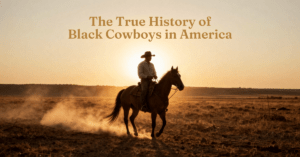
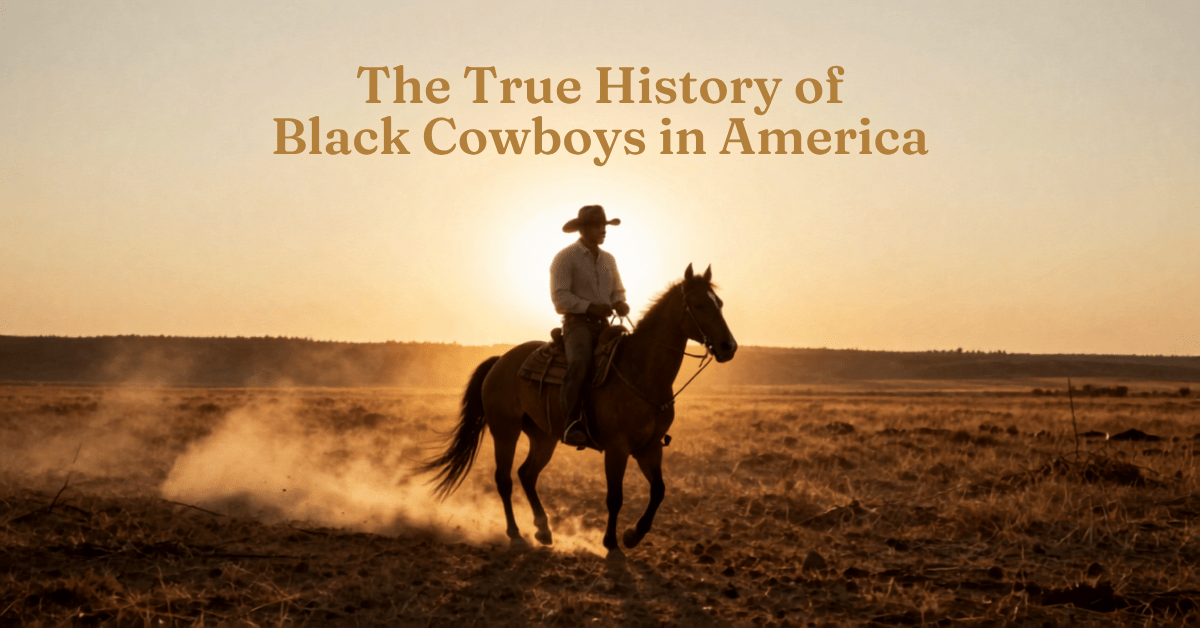
- 1 in 4 American cowboys in the post-Civil War era was Black — a historical fact most Americans were never taught.
- Thousands of formerly enslaved men became cattle drivers, ranch foremen, rodeo performers, and frontier lawmen.
- Hollywood deliberately erased Black cowboys from the Western myth — but historical records prove their presence.
- Faith was a central force in Black cowboy life, carried westward from the churches of the South.
- Dark Prairie by Lonesome B. Augustine brings this hidden chapter to life through visceral, faith-driven storytelling.
Every American child is raised on the image of the cowboy: white, rugged, riding alone into a sunset. It is one of the founding myths of American identity.
It is also, in significant ways, a lie.
The real history of the American cattle frontier is far more interesting — and far more diverse — than the myth. And at the center of that gap between myth and reality stands one of the most erased chapters in American history: the Black cowboy.
The Numbers They Don’t Teach in School
Historians who have examined payroll records, cattle drive logs, and period census data have consistently found the same astonishing figure: between 25% and 35% of all cowboys who drove cattle across the post-Civil War American West were Black.
That’s roughly 9,000 to 27,000 Black men — formerly enslaved, newly free, with nowhere to go and everything to prove — who became the foundational labor force of an industry that shaped American culture forever.
They rode the Chisholm Trail. They worked the King Ranch in Texas. They drove longhorns from South Texas to Kansas railheads across hundreds of miles of hostile terrain. They were skilled horsemen, expert ropers, and essential members of crews that could not afford to carry dead weight.
And then, almost entirely, history forgot them.
How the Erasure Happened
The erasure was not accidental. It was systematic.
When Hollywood began making Westerns in the early 20th century, the industry was producing films for a Jim Crow America. Black faces were unwelcome in heroic roles. The cowboy — already a potent symbol of American individualism and rugged virtue — was whitewashed to fit the racial politics of the era.
Textbooks followed. Popular culture drove the curriculum, not historical evidence. By the mid-20th century, multiple generations of Americans — Black and white alike — had absorbed a version of Western history that simply had no room for the people who were actually there.
The result is that most Americans, when they think of cowboys, picture someone who doesn’t look like Nat Love, or Bass Reeves, or Bill Pickett — three of the most remarkable figures the American frontier produced.
Three Black Cowboys Who Changed the West
Nat Love — “Deadwood Dick”
Born into slavery in Tennessee in 1854, Nat Love became one of the most celebrated cowboys of his era. He won a roping and shooting competition in Deadwood, South Dakota on July 4, 1876 — earning the nickname “Deadwood Dick” — and later wrote one of the earliest cowboy autobiographies, published in 1907. His book is still in print.
Bass Reeves — The Real Lone Ranger
Many historians believe that the fictional Lone Ranger was based on Bass Reeves, the first Black U.S. Marshal west of the Mississippi. Reeves was born enslaved in Arkansas, escaped during the Civil War, learned to speak several Native American languages, and went on to arrest more than 3,000 criminals during his career — with a near-perfect record for bringing fugitives in alive.
Bill Pickett — The Father of Bulldogging
Bill Pickett invented the rodeo technique of bulldogging (steer wrestling) and performed it for audiences across the United States, Canada, Mexico, and England. He performed before the King of England. He was inducted into the Pro Rodeo Hall of Fame in 1989 — one of the first Black inductees.
Faith on the Frontier
For Black cowboys — especially those who had survived enslavement — faith was not a Sunday ritual. It was daily armor.
The Black church traveled west with freedmen. In cattle towns like Abilene and Dodge City, Black congregations formed quickly. Traveling preachers rode circuits across the frontier. Scripture — memorized because reading had been forbidden under slavery — was recited in bunkhouses and on the trail.
This is the historical reality that Dark Prairie by Lonesome B. Augustine captures. The protagonist is not just a Black cowboy navigating a racially hostile frontier. He is a man whose faith is his compass — tested by violence and loss, refined by the specific spiritual tradition that Black Americans had built under impossible conditions.
That combination — rigorous historical accuracy plus genuine spiritual depth — is what makes the book unlike anything else currently available in faith-driven Black historical fiction.
Books About Black Cowboys Worth Reading
If this history is new to you, here are the books that will take you deepest into it:
Dark Prairie by Lonesome B. Augustine (Historical Fiction)
The novel that launched a thousand conversations at church book clubs. Set in post-Civil War Texas, it follows a Black cowboy whose faith, grit, and survival instincts are tested by the unforgiving frontier. Rooted in real history. Utterly unputdownable.
The Life and Adventures of Nat Love (Autobiography, 1907)
Written by Nat Love himself — a primary source document that reads like an adventure novel. Available in public domain reprints. Nat Love’s voice is immediate, proud, and completely authentic.
Black Cowboys of the Old West by Tricia Martineau Wagner (Nonfiction)
A solid overview of the historical record, with profiles of specific figures and attention to the documentary evidence. Good starting point for educators and readers who want the nonfiction foundation before exploring the fiction.
The Legend of Bass Reeves by Gary Paulsen (Historical Fiction, Young Adult)
Written for younger readers but gripping for adults too. A responsible introduction to Bass Reeves that sticks close to the historical record while making the story vivid for a new generation.
Why This History Matters Right Now
The history of Black cowboys is not just interesting — it’s corrective. It pushes back against a mythology that has been used, consciously and unconsciously, to make certain Americans feel like they don’t belong in certain spaces or stories.
When a Black child reads Dark Prairie or learns about Nat Love or Bass Reeves, something changes in how they understand their place in American history. They were always here. They built this too. They rode these same trails, under these same skies, with the same courage and the same faith.
That recognition is not a small thing. It is the work that good historical fiction — and good history teaching — is supposed to do.
Lonesome B. Augustine has built his writing life around that work. You can learn more about his books and speaking engagements at lonesomeaugustine.com.
Frequently Asked Questions: Black Cowboys in American History
How many cowboys in the American West were Black?
Historians estimate that between 25% and 35% of all cowboys who worked the cattle drives of the post-Civil War era were Black — roughly 1 in 4. An estimated 9,000 to 27,000 Black men worked as cowboys between 1865 and 1895.
Who was the most famous Black cowboy in American history?
Nat Love (also known as “Deadwood Dick”) is among the most celebrated. He was born into slavery, became a cattle driver, and wrote one of the first cowboy autobiographies in 1907. Other notable figures include Bass Reeves, the first Black U.S. Marshal west of the Mississippi, and Bill Pickett, the legendary rodeo performer.
Why aren’t Black cowboys taught in American history classes?
The erasure of Black cowboys from mainstream history reflects a broader pattern in how American mythology was constructed. Hollywood Westerns deliberately whitewashed the cowboy image. Textbooks followed pop culture rather than historical records, leaving generations with an inaccurate picture of who actually settled and worked the American West.
What are the best books about Black cowboys?
Top picks include: Dark Prairie by Lonesome B. Augustine (historical fiction), The Life and Adventures of Nat Love (autobiography), Black Cowboys of the Old West by Tricia Martineau Wagner (nonfiction), and The Legend of Bass Reeves by Gary Paulsen (young adult).
Is Dark Prairie by Lonesome B. Augustine based on real history?
Yes. Dark Prairie is rooted in the real history of Black cowboys in post-Civil War Texas and the frontier West. Author Lonesome B. Augustine spent years researching the period to create a story that feels true because it is grounded in what actually happened.
What role did faith play in the lives of Black cowboys?
For many Black cowboys — especially those who were formerly enslaved — faith was a foundational survival resource. The Black church followed freedmen westward, and scripture and prayer were daily realities for many of these men and women.
Were there Black cowgirls too?
Yes. Black women also worked on ranches and frontier towns. Mary Fields (“Stagecoach Mary”) is one of the most famous, known for driving mail routes in Montana in the 1890s. Women’s roles on the frontier were diverse and often erased alongside the men’s stories.
What is Black cowboy historical fiction?
Black cowboy historical fiction centers Black protagonists in the American West — typically the post-Civil War era. These novels use documented history as their framework while creating fictional characters whose experiences reflect what Black men and women actually endured and achieved in that period.
Lonesome B. Augustine is a faith-driven Black history author and Christian speaker based in Fredericksburg, Virginia. His novel Dark Prairie recovers the untold story of Black cowboys on the American frontier. He speaks at churches, schools, and community events on faith, history, and the power of storytelling. Learn more →